Broken Glass Art: The Complete Guide to Cracked & Shattered Glass Art
What broken glass art is, how it is made, the three techniques, and what to know before you commission or buy a piece, explained by broken glass artist Yasin Uca.
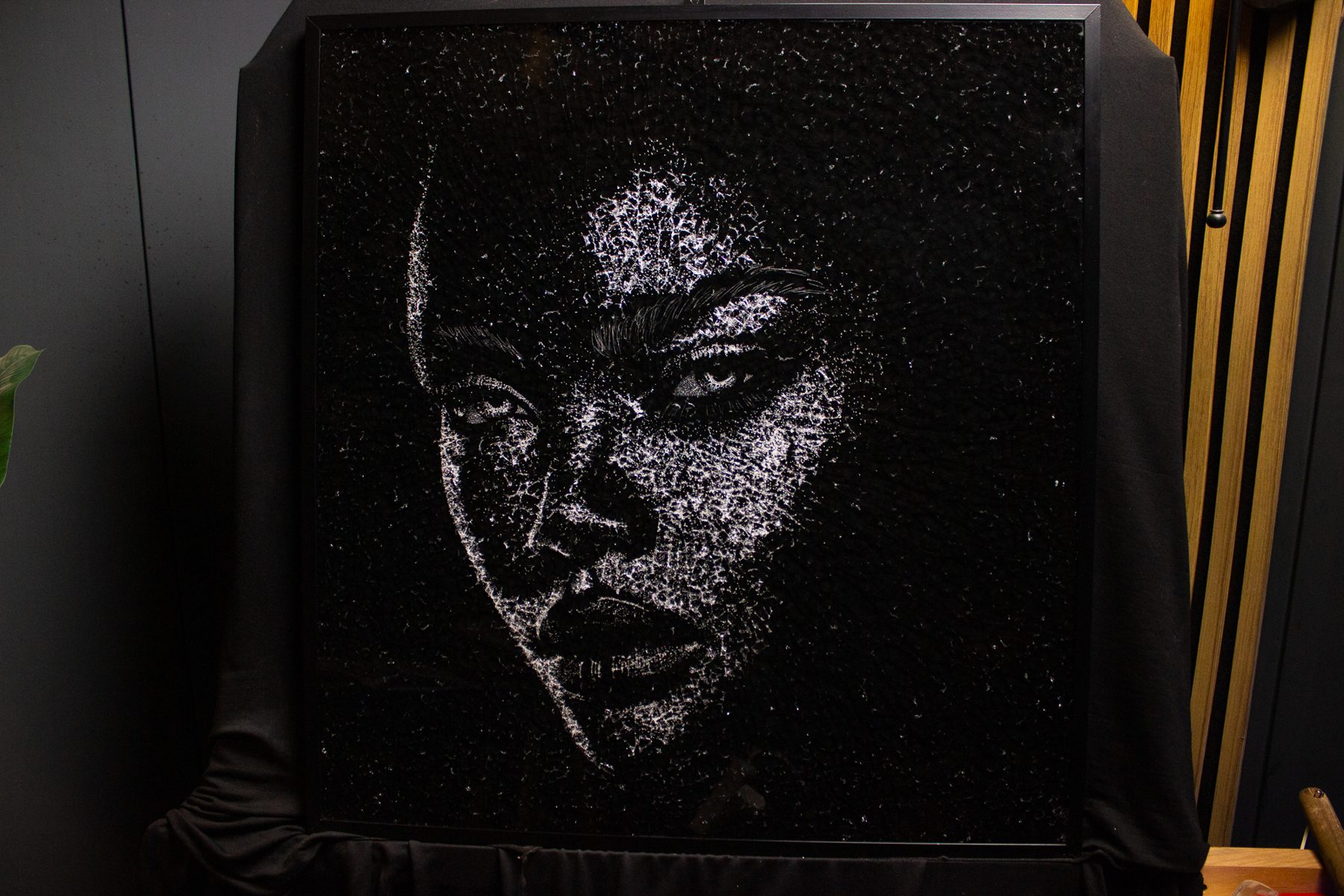
Broken glass art is the art of drawing with fractures. I strike a sheet of laminated glass thousands of times, and every strike leaves a crack that catches the light. Put enough of them in the right places, and a face looks back at you from the glass.
We are taught to protect fragile things. A glass slips off the table, a phone hits the floor, a window cracks, and our first thought is loss. I see something else in those fractures. I see lines, reflections and patterns that would never have existed if the glass had stayed whole. I have spent the last six years, and more than 70 broken glass artworks, learning to command them.
This guide is everything I know about this art form: what it is, how I make it, how you can try it, and what to expect if you decide to own a piece.
What Is Broken Glass Art?
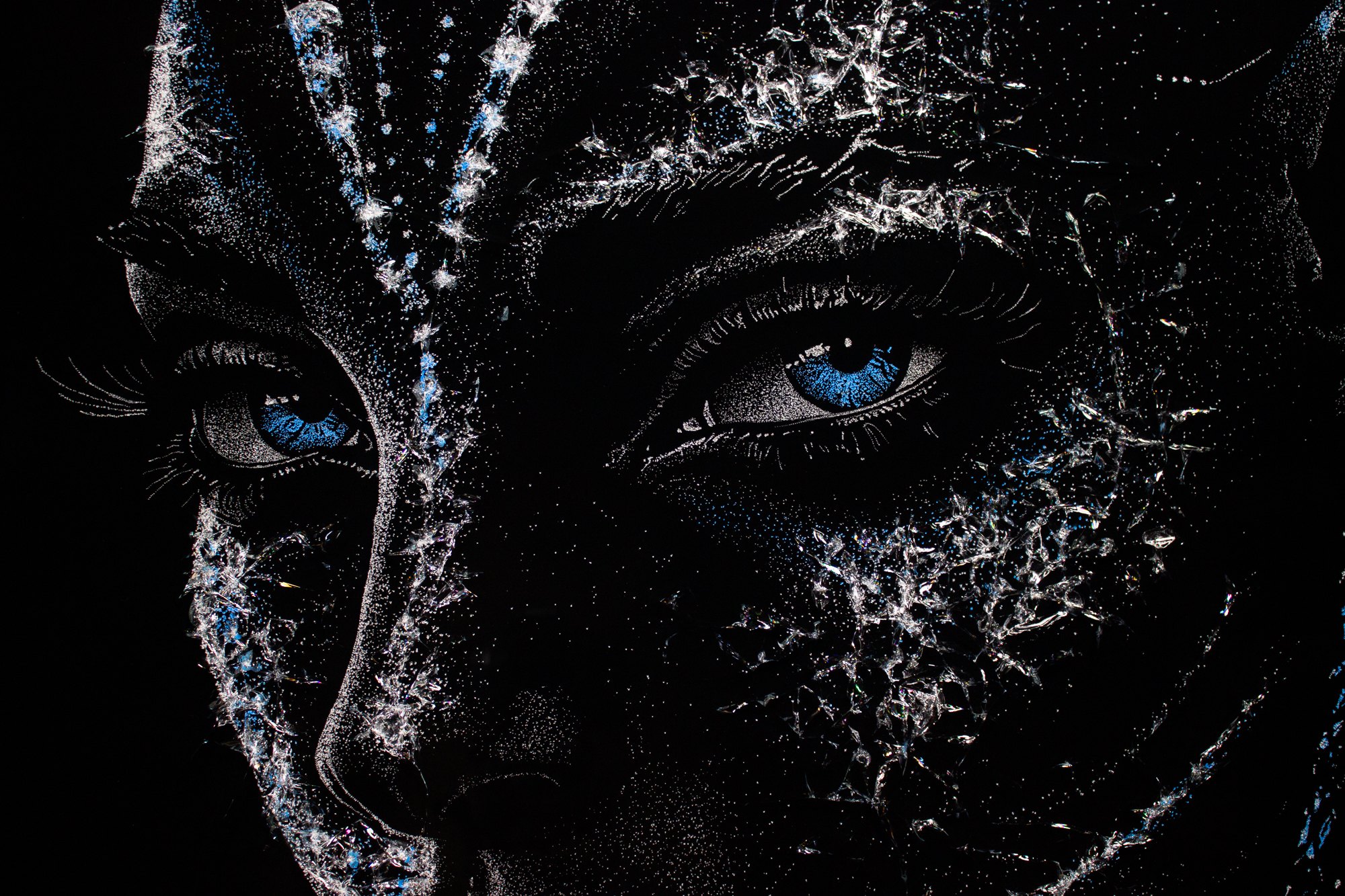
Broken glass art is an art form in which the image is created by deliberately fracturing glass. The image itself is never printed or painted: the fractures draw it. Two things support them. Behind the glass sits a black background that gives every crack its contrast, and in some works I set blue pigment into selected micro-fractures as an accent. The drawing, though, is always the cracks, and the light they reflect and scatter.
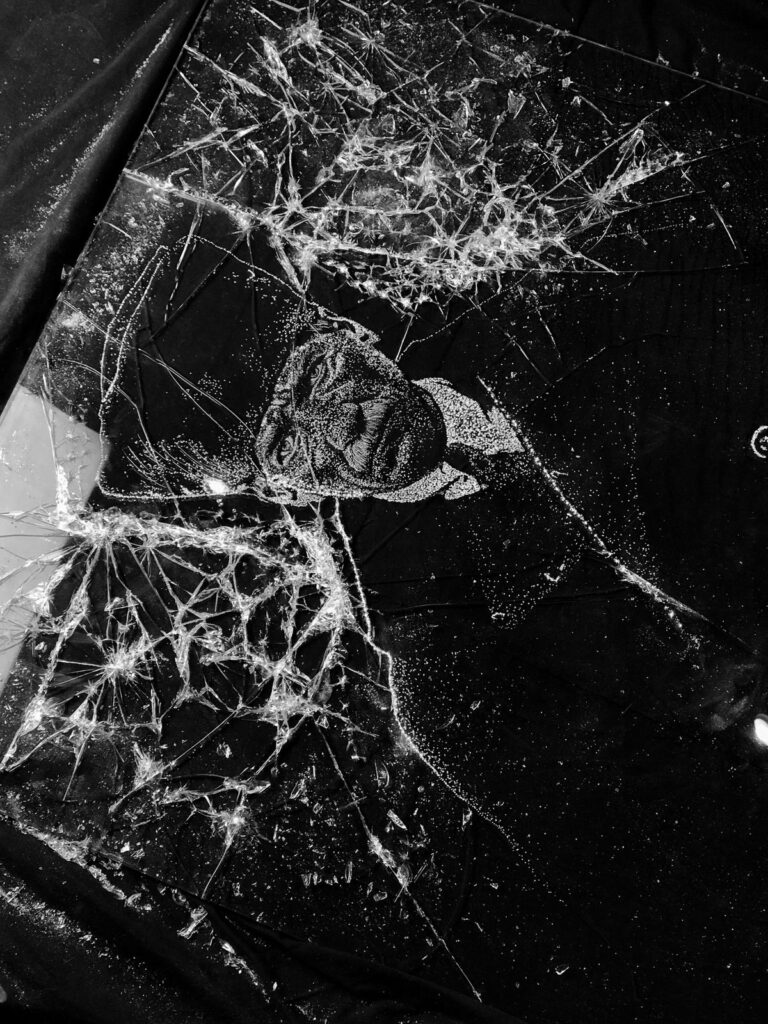
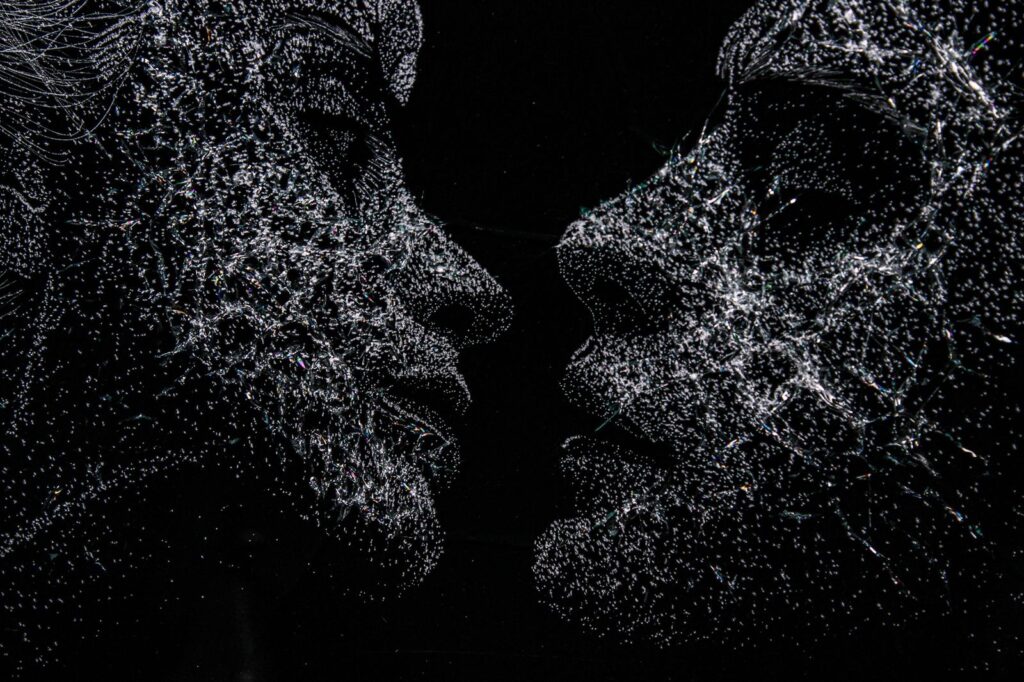
The word “broken” misleads people. They imagine glass smashed into pieces. In my work, each strike opens a hairline fracture, often less than a millimeter across, inside a laminated sheet that stays in one piece. That fracture reflects light back towards you as a tiny white point, almost exactly like a single pixel on a screen.
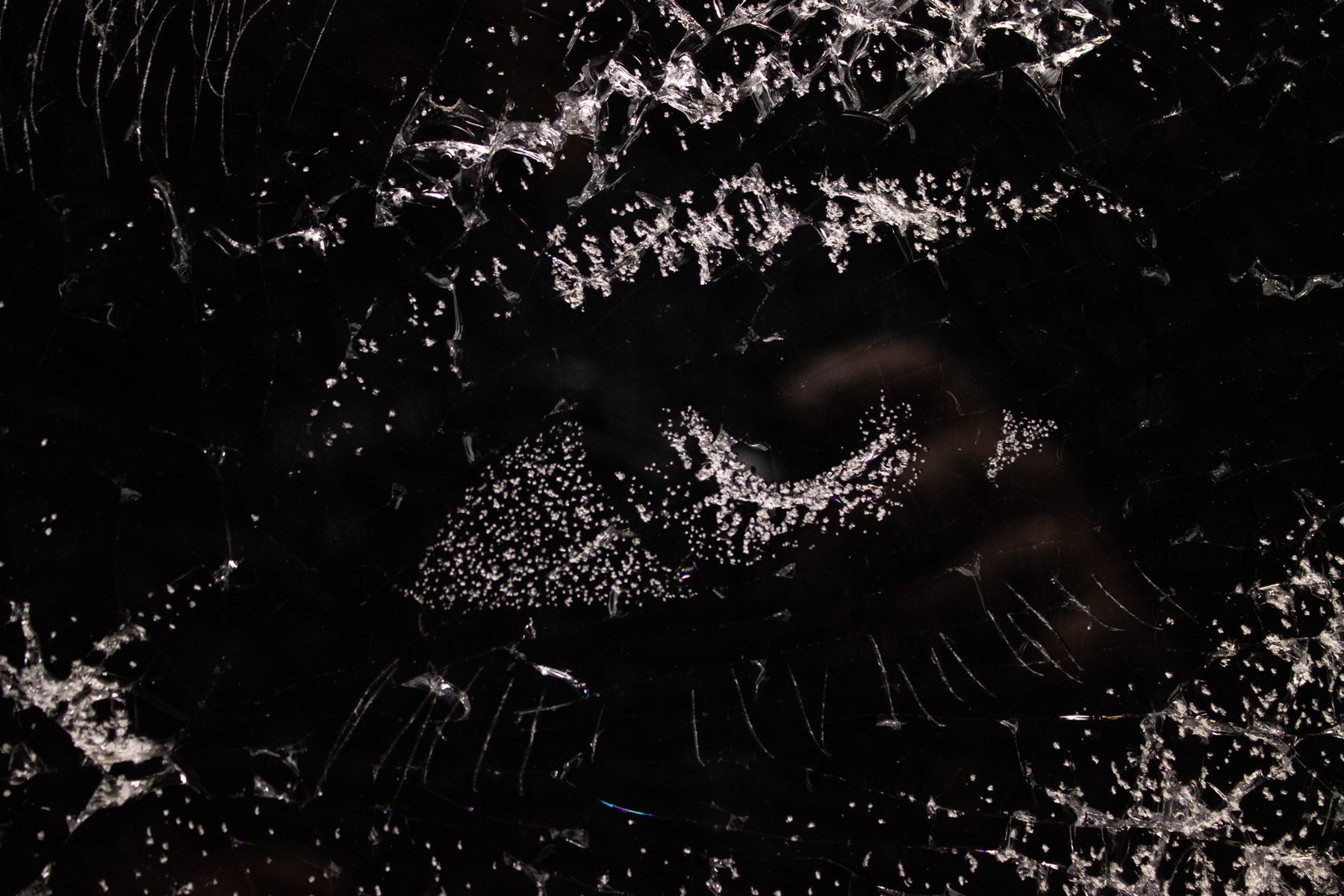
I control the density, placement and direction of those pixels. Bright areas of a face are dense with fractures; dark areas are left almost untouched, and the black background shows through them. From across the room you see a portrait. Step closer and it dissolves into thousands of individual decisions, each one permanent.
The material that makes all of this possible is laminated safety glass. Mine is an 8 mm panel: two 4 mm glass layers bonded by an EVA interlayer. The front layer is my working surface, the place where every fracture happens; the back layer and the EVA support it and hold the cracked front together as one piece. Without that structure, the first strike would be the last.
How a crack turns into light
Glass is transparent because light passes straight through it. A fracture interrupts that path. It creates tiny new surfaces inside the glass, and those surfaces reflect and scatter the light that falls on them. Depending on the shape of the crack and the angle of the light, it can look brilliant white, faintly silver or almost invisible. If you want to see how radial and concentric cracks behave, I keep a visual reference in How Cracks Form in Glass.
That is my entire palette. A painter controls an image with pigment; I control it with the number, size and direction of fractures, and with the glass I decide to leave alone. Anyone can crack glass. The real difficulty is knowing which parts of the sheet must stay untouched, because darkness is half of every portrait.
How I Design a Piece: Composition Before the First Crack
Breaking the glass is the last part of the decision, not the first. Before I strike anything, I design the piece the way a photographer designs light. I decide where the face sits in the frame and how much black space surrounds it, because in this medium empty darkness is not leftover space; it is what makes the light mean something.
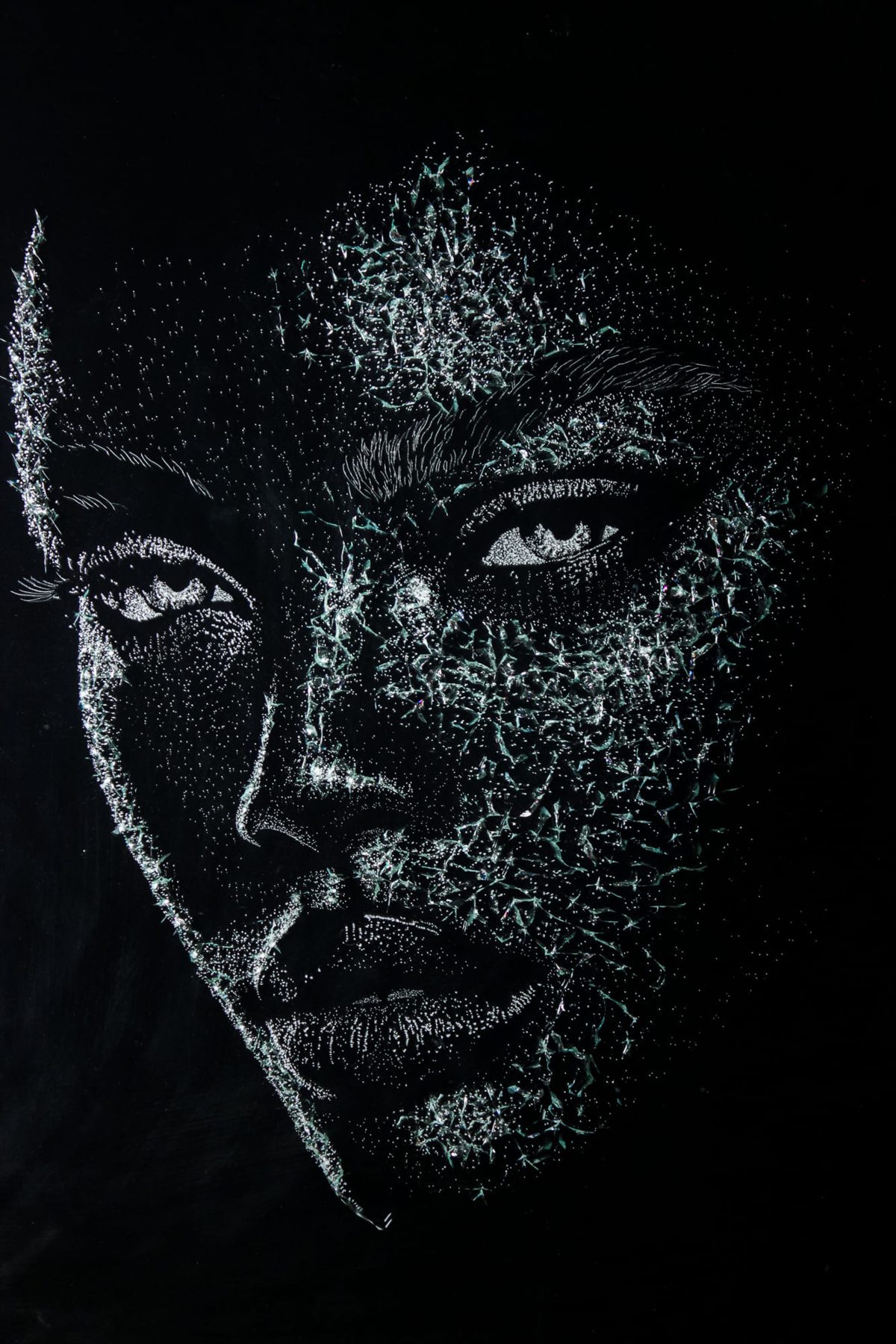
Then I choose the key light: the one brightest area the eye will land on first, usually in the eyes or along one side of the face. Everything else is measured against it. I plan which areas will be built with fine pointillism and which with long fractures, and I think about the direction of those fractures, because a crack is a line and a line leads the eye. Finally, I imagine the piece on a wall, lit from above or catching side light, since the room’s light will finish the work I start. When a commission begins with a feeling instead of a photo, the same thinking applies; only the starting point changes.
Why Every Piece of Broken Glass Art Exists Only Once
Two broken glass artworks can share a composition, but never their fractures. Not two of mine, not two of anyone’s.
Take two sheets of glass that left the same factory side by side. Strike both with a machine, at exactly the same points, with exactly the same force. You will get two different crack networks. Fracture follows the glass’s own internal stresses and microscopic flaws, and no artist, machine or software controls those.
I can return to a composition. I can work from the same reference photograph with the same tools. I still cannot make the same fracture twice. For me this is not a limitation. It is the whole point: a collector does not buy an image, they buy a physical event that happened once.
Broken, Cracked, Shattered or Fractured Glass Art?
You will find this art form called broken glass art, cracked glass art, shattered glass art, fractured glass art or glass break art. They describe the same family of work: images made by breaking glass on purpose. If you want the most accurate word, it is “cracked” or “fractured”, because the glass is cracked in place, never smashed apart. More on the terms in What Is Broken Glass Art Called?, and on why people sometimes call these works sculptures in Broken Glass Sculpture or Portrait?
Where This Art Comes From
Artists have worked with broken glass for centuries. Mosaic makers and stained glass masters built images from cut and broken pieces long before anyone imagined a fractured portrait. In the 20th century, one of modern art’s best-known glass works cracked in transit, and its artist chose to keep the cracks as part of the work.
What I do belongs to a younger tradition. I do not assemble fragments. I work inside a single laminated sheet, and the fractures themselves become the image.
Broken Glass Art vs Stained Glass, Mosaic and Engraving
They share a material, but they are different crafts. I have worked in stained glass and mosaic myself, and they shaped how I understand glass, yet controlled fracture asks for something none of them do: the material does not just receive the image, its own response becomes part of it.
| Technique | How the image is made | Role of the glass |
|---|---|---|
| Stained glass | Colored pieces are cut and joined with lead or copper | Carries color and light |
| Glass mosaic | Small pieces are arranged and set side by side | Acts as individual tiles |
| Glass engraving | Material is cut or ground away from the surface | Is carved like stone |
| Broken glass art | Controlled fractures inside one laminated sheet | The cracks themselves are the image |
The Three Techniques I Work With
Every CRACASSO piece is built with one of three techniques. Each speaks a different language of light.
1. Pointillism (micro-fracture stippling). The image is made entirely of tiny fractures, thousands of controlled strikes, each one a point of light. It is the most realistic technique I have: eyes, lips, the shadow under a cheekbone, all of it can be carried into the glass. It is also the most unforgiving. One strike with a little too much pressure in a dark area leaves a white spot like a blemish on skin, and glass has no eraser.
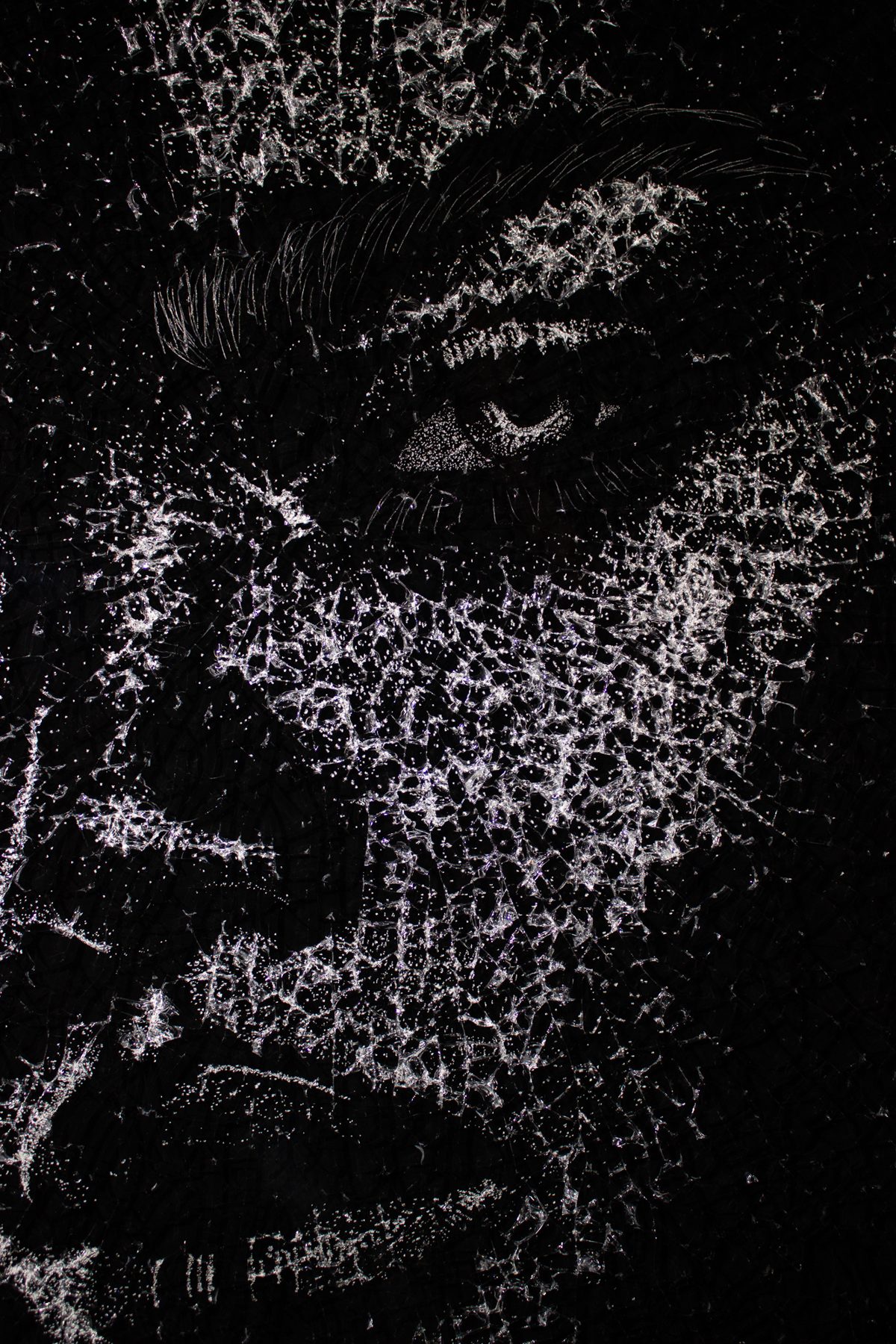
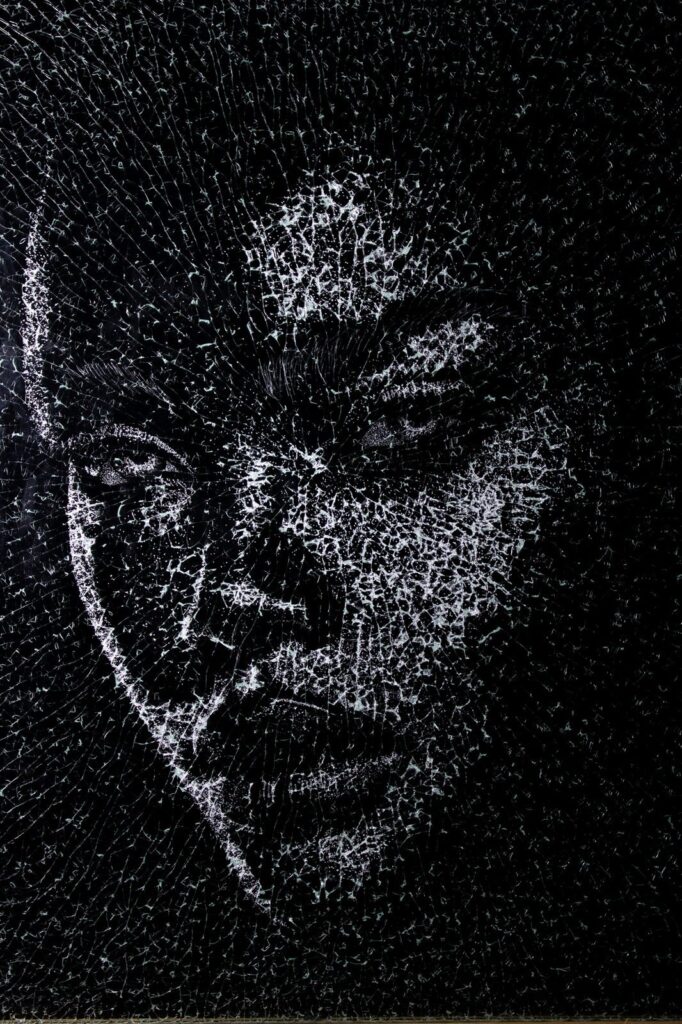
2. Full fracture. Here I want long cracks that run across the sheet. They travel perpendicular to the surface, so they do not glow as white points. They bend light depending on where you stand, and the work shifts as you walk past it. The glass decides more here: sometimes the crack I need refuses to form, and sometimes it splits its neighbors instead.
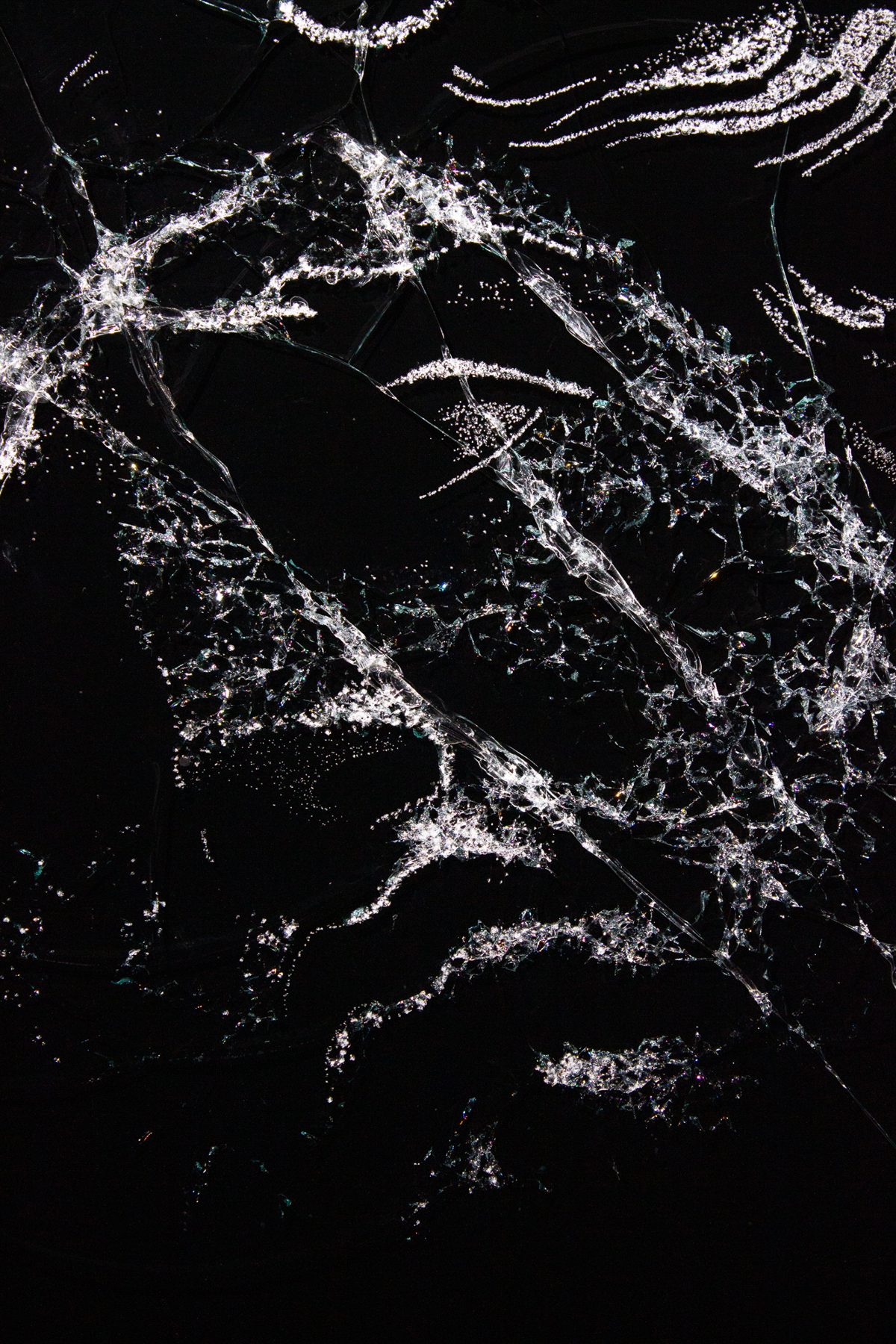
3. Hybrid. The two languages in one piece. Full fractures build the drama and depth of the composition, while pointillism handles what has to be exact: the key light, the eyes, the nose, the lips, the line of an eyebrow. Precision where you look first, movement everywhere else.
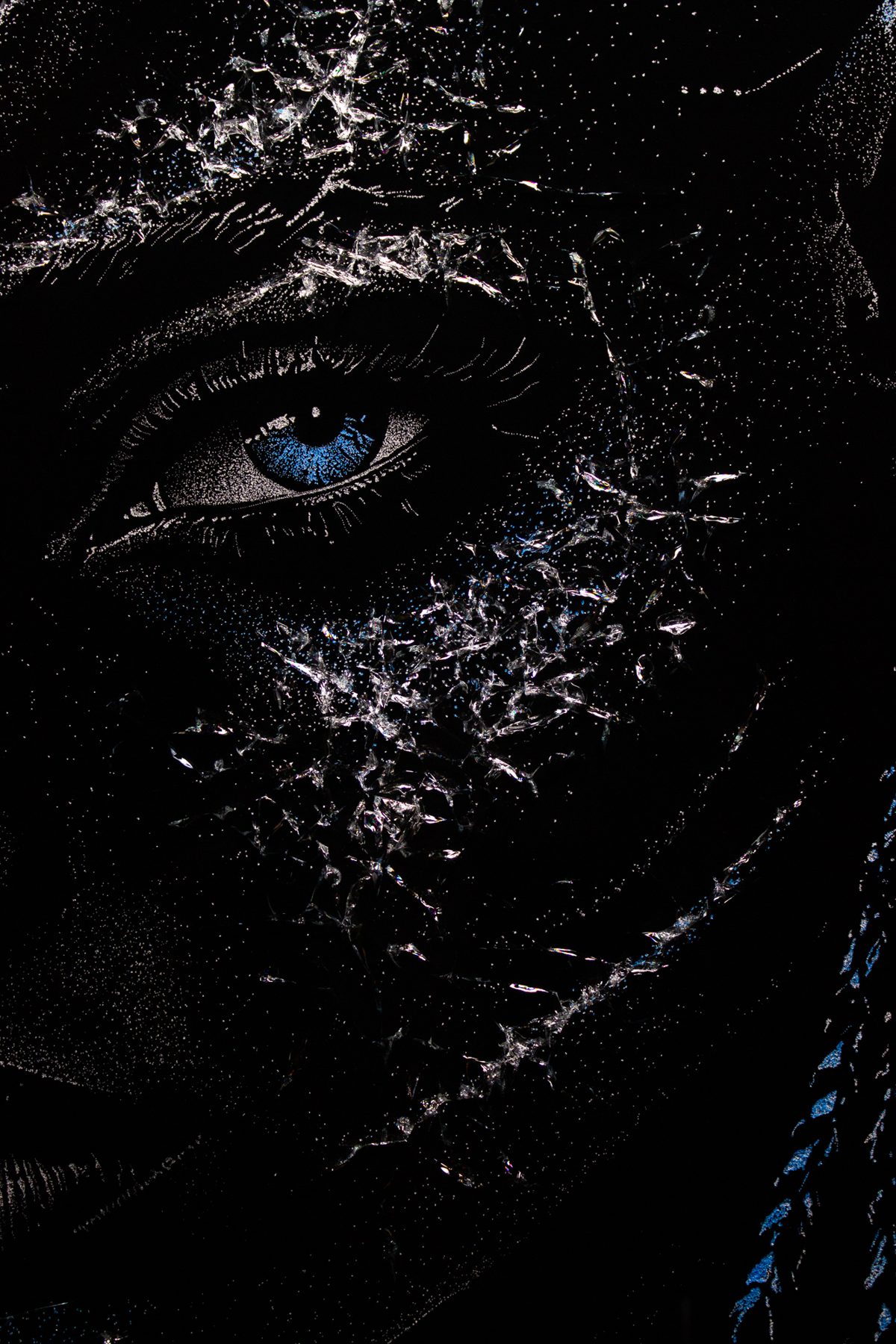
I explain each technique step by step, with the tools I use, in How Broken Glass Art Is Made.
Can You Make Broken Glass Art Yourself?
Yes, and I encourage you to try. Just do not believe anyone who tells you it is easy. Breaking glass is the easy part. Understanding what happens after the first crack takes years.
Here is what you need to begin:
- Protection before anything else. Fracturing glass produces fine particles and sharp fragments. Wear safety glasses with side shields, cut-resistant gloves and a fine-particle mask (FFP2/FFP3). Keep the work area clean with a damp cloth or a HEPA vacuum, never by dry sweeping.
- Laminated glass. Ordinary glass can break unpredictably into sharp pieces. In laminated glass, the interlayer holds the fragments in place, which is what makes controlled fracture possible. It still needs careful handling.
- A hard, rigid surface underneath. You want the force to shape the front of the glass, not disappear into a soft table.
- A hard tip. In my studio, ordinary nails went blunt within days because glass is harder than they are. Tungsten carbide lasts far longer, and in my experience diamond tips have given the best results.
- Patience. Working the glass of a standard 80 × 75 cm piece usually takes me 5 to 10 days. Your first pieces will take longer, and some will be ruined. Keep going: every ruined sheet teaches you something.
The full beginner’s guide, from transferring your reference to making your first crack, is in How Broken Glass Art Is Made.
If you take only one thing from this section, take this: the glass is not a canvas that obeys. Treat your first sheets as conversations with the material, not as finished works.
The Artist Behind CRACASSO
I am Yasin Uca, a Turkish artist, and I have made things with my hands since I was a boy carving wooden swords. I met glass in high school through mosaics and stained glass, and it frustrated me endlessly: it cracked where it wanted and broke when the temperature changed. Years later, that same stubbornness became the reason I could not leave it alone.
My first broken glass piece, an abstract female figure, looked like a damaged sheet when I finished it. I leaned it in a corner at home instead of throwing it away. The next morning, side light hit it and every crack came alive. Since then I have made more than 200 works across mosaic, stained glass, string art and charcoal, and for the last six years almost only broken glass: more than 70 pieces, now with more than fifty collectors in around fifteen countries. The name says it all: crack, plus Picasso.
More about my path, my exhibitions and how I work with collectors is on my artist page.
Why People Collect Broken Glass Art
Everyone has watched glass break. Almost no one has watched it break into a face. That gap is where this art lives.
At every exhibition and showroom I have been part of, from the Hüseyin Kolay Culture & Art House in Kızılcaköy in 2025 to the Aydın Women’s Rights Protection Association in 2026, the same thing happens. People stop. They ask whether it is engraved, painted, printed. They lean in, and only then do they understand that the whole image is made of cracks. Their minds struggle with it, because we have all learned that broken glass means chaos. In the right hands, that cold, hard material opens into something close to a fourth dimension.
Collectors come to it for three reasons. It is impossible to copy. It changes with the light and with the person looking at it. And it carries meaning: a person, a memory, a feeling, held in a form that cannot be repeated.
No photo has ever done it justice
This is the honest handicap of my medium: it never looks as good on a screen as it does on a wall. A photograph freezes one angle of light. In a room, the fractures answer every step you take. Small flashes of pink, blue and rainbow color appear and vanish, and a line that was dark a second ago suddenly catches fire. At exhibitions I have watched people stop in front of these pieces again and again; on a wall at home, it tends to become the piece guests ask about.
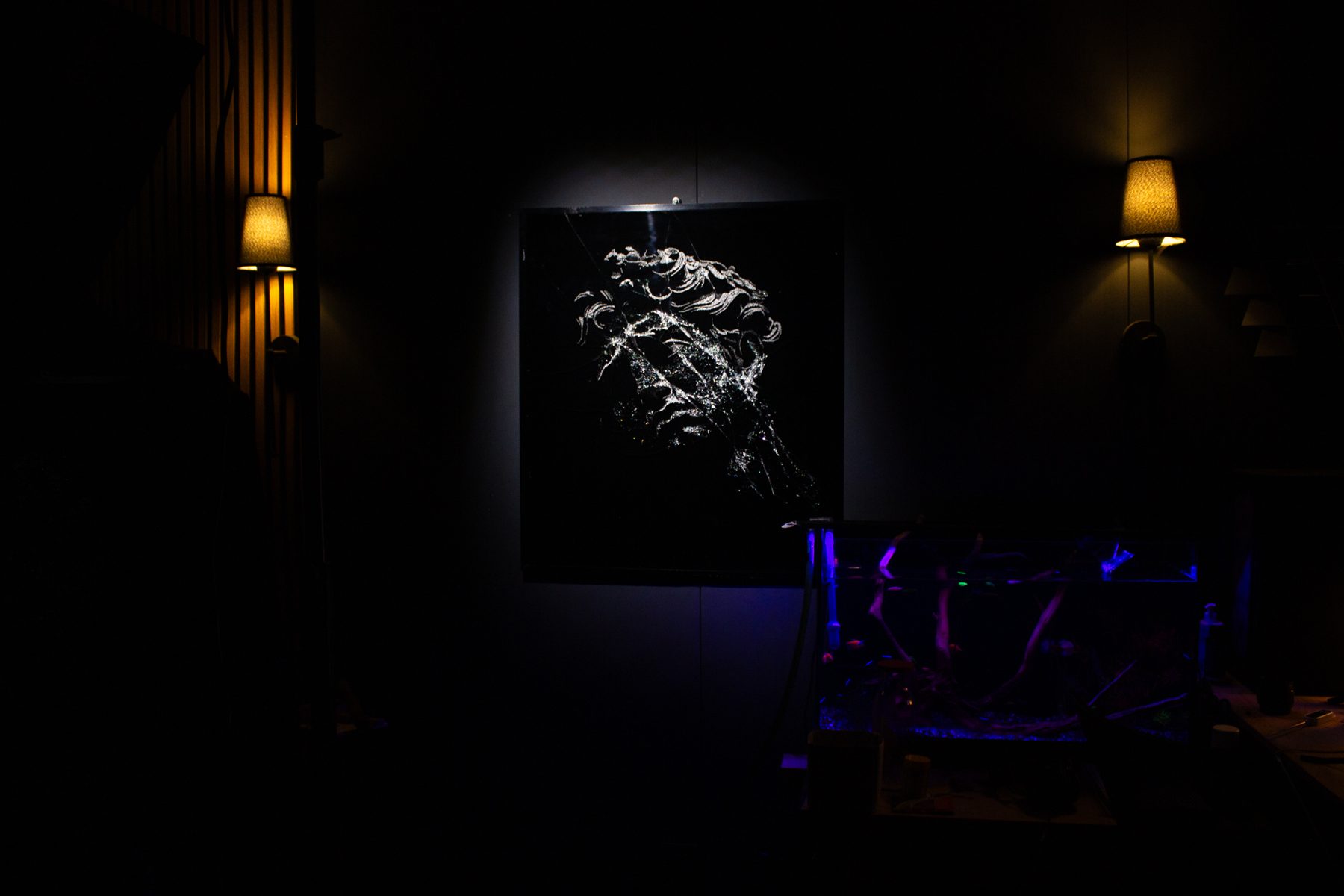
An emotional time capsule
I think of my works as time capsules. You may walk past one every day without stopping. Then, years later, something changes in your life, you look at it again, and it means something new. The fractures have not changed. You have.
That is why so many commissions are memorial portraits. In those pieces the work stops being an image and becomes a place where a memory can live.
Owning Broken Glass Art: Commissions, Prices and Care
Much of my work is commissioned. Portraits are where the medium shines, one to three people in a clear, well-lit photo, but I have also made pets, cars, watches, athletes, Formula 1 drivers, actors and musicians. You can even arrive without a photo: tell me a feeling and the story behind it, and I will design a piece around it. The one thing I usually turn down is landscapes, because their endless detail and color do not survive the translation into cracks.
The process is simple and nothing is paid until the design is agreed. You send two to five photos or a story, we agree on composition, size and a fixed price, and a 40% deposit reserves your place in the studio calendar. When the framed piece is finished, you see photos, pay the remaining 60%, and it ships by FedEx in a custom wooden crate. Commissions start at $1,200 and are priced by the design, not by the square centimeter; ready works from the collection currently start at $2,000.
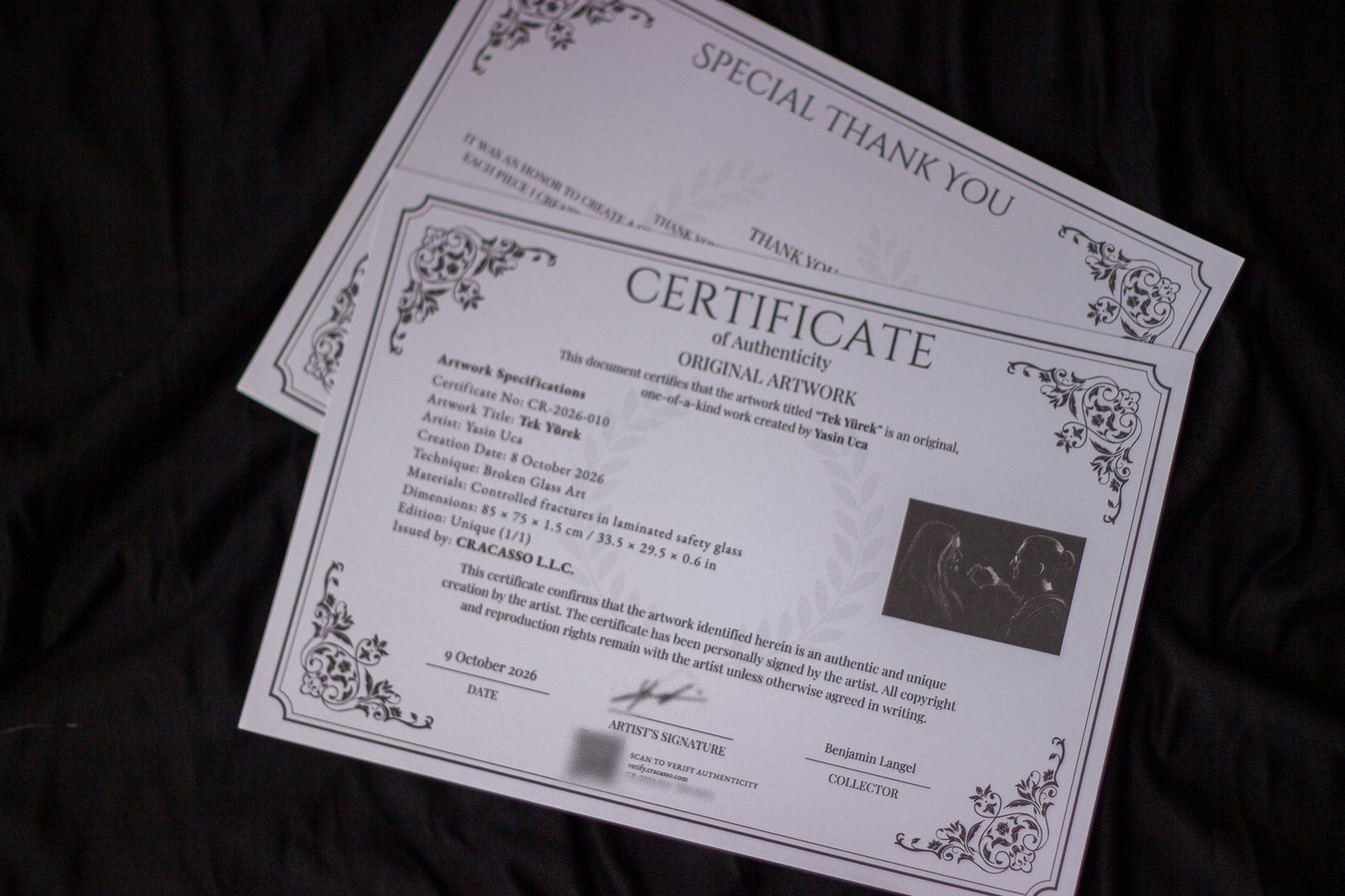
Living with one is easier than people expect. The cracks are inside the glass, so the surface feels almost smooth, and care is simple: dust the glass with a soft dry cloth and never spray liquids onto it. Every piece sits in a black 6063 aluminum frame, carries a signed, numbered certificate of authenticity, and stays connected to the studio through lifetime artist care.
Everything a collector needs to know is already on the site: the commission page for the process, the price guide, how to choose a photo, how to light and display the work, safety and durability, and the full shipping, returns and terms. Or browse the works available now.
Frequently Asked Questions About Broken Glass Art
What is broken glass art called?
It is also called cracked glass art, shattered glass art, fractured glass art or glass break art. All of these describe images created by fracturing glass on purpose.
Is broken glass art hard to make?
Yes. Anyone can crack glass. Controlling where and how it cracks takes years, and every strike is permanent.
What glass do you use?
Laminated safety glass, whose interlayer holds the cracked glass together. Mine is an 8 mm panel of two 4 mm layers bonded by an EVA interlayer; I work only on the front layer.
What tool cracks glass best?
A hammer and a hard tip. In my experience, tungsten carbide holds up well and diamond tips give the best results. Ordinary nails go blunt quickly.
Is any paint or pigment used?
The image is made by fractures, not paint. A black background sits behind the glass, and some works carry blue pigment set into selected micro-fractures as an accent.
How long does a commission take?
The glass work itself usually takes me 5–10 days, once the glass has been cut to size. From design approval to dispatch, allow about 2–3 weeks, plus FedEx delivery of typically 5–7 business days. These are estimates, not guaranteed dates.
How much does broken glass art cost?
CRACASSO commissions start at $1,200 for smaller, simpler designs and are priced by the design; larger or more detailed pieces cost more, and shipping is quoted separately. Ready works currently range from $2,000 to $2,500.
Can you make a portrait of someone who has passed away?
Yes. Memorial portraits are among the most meaningful works I make. A clear, well-lit photo of the face is what I need.
Can you work from an old or blurry photo?
Often, yes. I prepare a cleaner working reference first and show it to you before I begin, so the face stays true to the person.
A Crack Is Not Art. Intention Is.
I have never believed that glass becomes beautiful just because it is broken. A single crack is an accident, and a thousand cracks are still only damage. A work of art begins when every fracture has a reason to be where it is: to hold the light in someone’s eye, to leave a shadow dark, to carry a memory. The cracks are my medium. The meaning is my job.
If you want to go deeper, start with how broken glass art is made, meet the artist behind CRACASSO, or see the works available now. When you are ready, commission your own portrait.